Mysterious Blue Flashes in Space: Could Black Holes Crashing Into Stars Be the Cause?
Astronomers have been puzzled by brief, brilliant blue explosions known as Luminous Fast Blue Optical Transients (LFBOTs). These cosmic flashes appear suddenly, shine intensely for days, then fade away. New research suggests they may result from a black hole or neutron star slamming into some of the universe's hottest stars. This Q&A explores the leading theory behind these enigmatic events.
What exactly are Luminous Fast Blue Optical Transients (LFBOTs)?
LFBOTs are a class of extremely bright, fast-evolving cosmic explosions. They emit most of their energy in blue light, are typically visible for only a few days, and can be as luminous as a supernova but fade much quicker. First discovered in 2018 (the event AT2018cow), they have since been detected in distant galaxies. Their rapid rise and fall in brightness, along with their unusual blue color, make them distinct from typical supernovae or gamma-ray bursts. Astronomers are still working to identify their exact origins, but their unique properties suggest a special type of catastrophic event.
Why are LFBOTs such a mystery to astronomers?
LFBOTs challenge existing models of stellar death because they don't fit neatly into known categories. Typical supernovae result from the collapse or explosion of giant stars and fade over weeks or months. LFBOTs, however, brighten and dim in just days, implying a compact energy source. Their blue color indicates extremely high temperatures—often exceeding 20,000 Kelvin. The lack of hydrogen in their spectra also hints at a progenitor star that has shed its outer layers. These traits have led to numerous hypotheses, but no single theory has explained all observed features until the recent proposal involving a black hole or neutron star colliding with a very hot star.
How could a black hole or neutron star crashing into a hot star produce a blue flash?
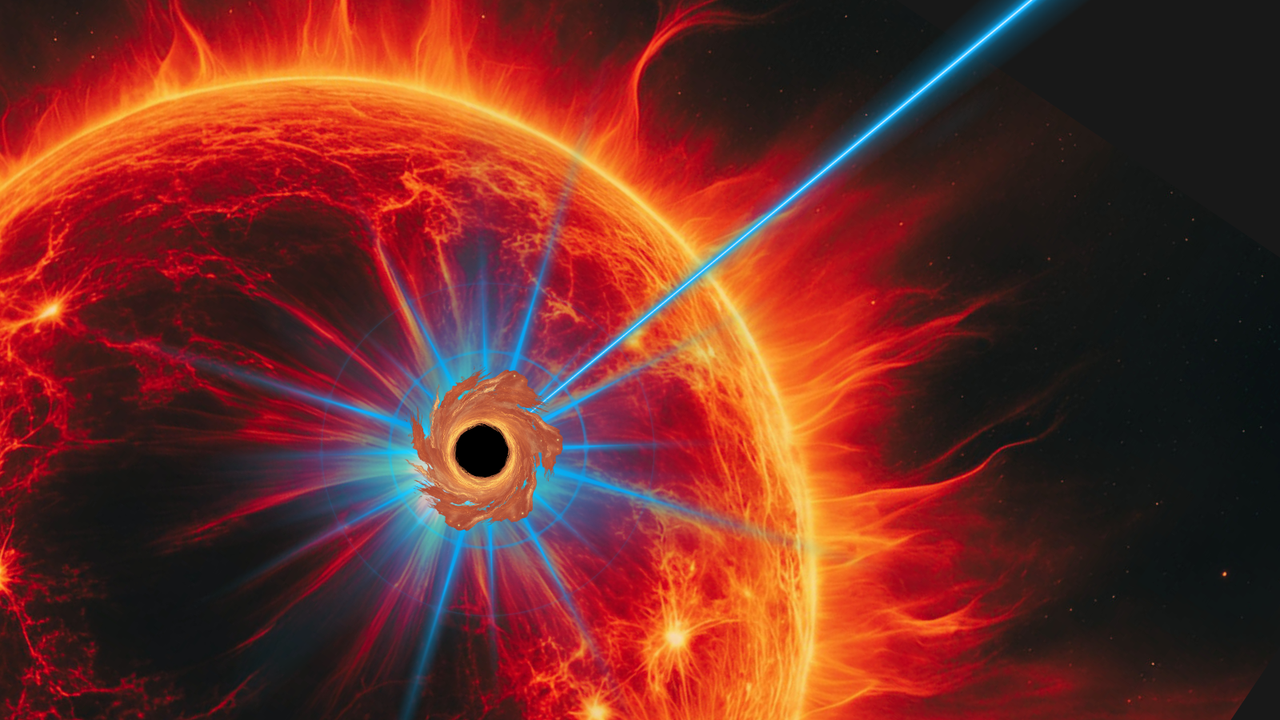
If a black hole or neutron star passes close to a massive, extremely hot star (like a Wolf–Rayet star), it could be captured by gravity and eventually plunge through the star's envelope. The collision would create a shockwave that heats the stellar material to tremendous temperatures, producing a bright blue flash. The black hole or neutron star might then spiral inward, dragging material along and causing rapid, intense energy release. Because the interaction is violent but brief, the resulting explosion would fade quickly—matching the short-lived nature of LFBOTs. The blue color comes from the high-temperature emission of the shocked gas, which peaks in the ultraviolet and blue parts of the spectrum.
What are the "hottest class of stars" mentioned in the theory?
These are Wolf–Rayet stars—massive, evolved stars that burn at extremely high temperatures (often over 50,000 Kelvin) and have lost their outer hydrogen layers due to powerful stellar winds. They are among the most luminous and hot stars in the universe. Because they are so massive (typically 20–100 solar masses), they have strong gravitational fields and can capture neutron stars or black holes more easily. Their intense radiation also strips away material, making the environment ripe for dramatic collisions. Several LFBOTs have been found near star-forming regions where Wolf–Rayet stars are common, supporting the connection.
Could there be alternative explanations for LFBOTs?
Yes, several other mechanisms have been proposed. One idea is that LFBOTs are failed supernovae where a massive star collapses directly into a black hole, but only part of its matter is ejected. Another model involves magnetars—highly magnetized neutron stars—that release vast energy after forming inside a supernova. Some scientists suggest they could be tidal disruption events where a black hole shreds a passing star, though the timescales don't always match. The black hole/neutron star collision with a hot star is currently one of the most promising because it naturally explains the blue color, rapid fading, and hydrogen-poor spectra, but more observational evidence is needed.
How can future observations confirm this theory?
To verify the collision scenario, astronomers need to detect gravitational waves or neutrino emissions from a LFBOT—signals that would directly indicate a compact object merger. High-cadence surveys (like those from the Vera Rubin Observatory) could catch LFBOTs in their earliest moments, revealing the shock breakout. Follow-up spectroscopy at different wavelengths (X-ray, radio) would probe the environment. If a LFBOT is found occurring in a region devoid of young hot stars, or if its properties consistently align with the predicted signature of a black hole–Wolf–Rayet collision, confidence will grow. Meanwhile, theorists are running detailed simulations to see if the model reproduces the full range of observed LFBOT light curves.
What does the discovery mean for our understanding of the universe?
If confirmed, this mechanism would reveal a new way that black holes and neutron stars interact with their environments—not just by consuming stars, but by smashing into them and triggering exotic explosions. It would also provide a fresh probe of the densest regions around massive stars, where compact objects are likely to be found. Moreover, LFBOTs might become important standard candles or markers for studying star formation and galaxy evolution. Ultimately, solving the mystery of blue flashes could reshape our picture of how the universe's most energetic events occur and what roles black holes and neutron stars play in them.