Young Innovators Win $10,000 OpenAI Prizes for Creative AI Solutions
OpenAI’s ChatGPT Futures program recently awarded $10,000 grants to 26 students and young innovators who are using artificial intelligence to solve real-world problems. From accessible gaming for the blind to AI models for neurological disease research, these projects showcase how a new generation harnesses AI for social good. This Q&A explores the stories behind some of the winning projects and the impact of AI in education and beyond.
What motivated Crystal Yang to create accessible audio games?
When Crystal Yang was in high school, she and her friends loved playing the online game Wordle. But one friend, who is blind, couldn’t participate. This inspired Yang to collaborate with researchers at Texas A&M University on conversational audio interfaces for the game. She then founded a nonprofit called Audemy, which has developed over 50 audio-powered games for blind and visually impaired players. The organization is now prototyping an accessible gaming console that uses audio and tactile feedback and works without Wi-Fi. Yang credits AI with helping her learn user research, write formal papers, design game templates, and evaluate hardware components—multiplying her capabilities to champion accessibility.
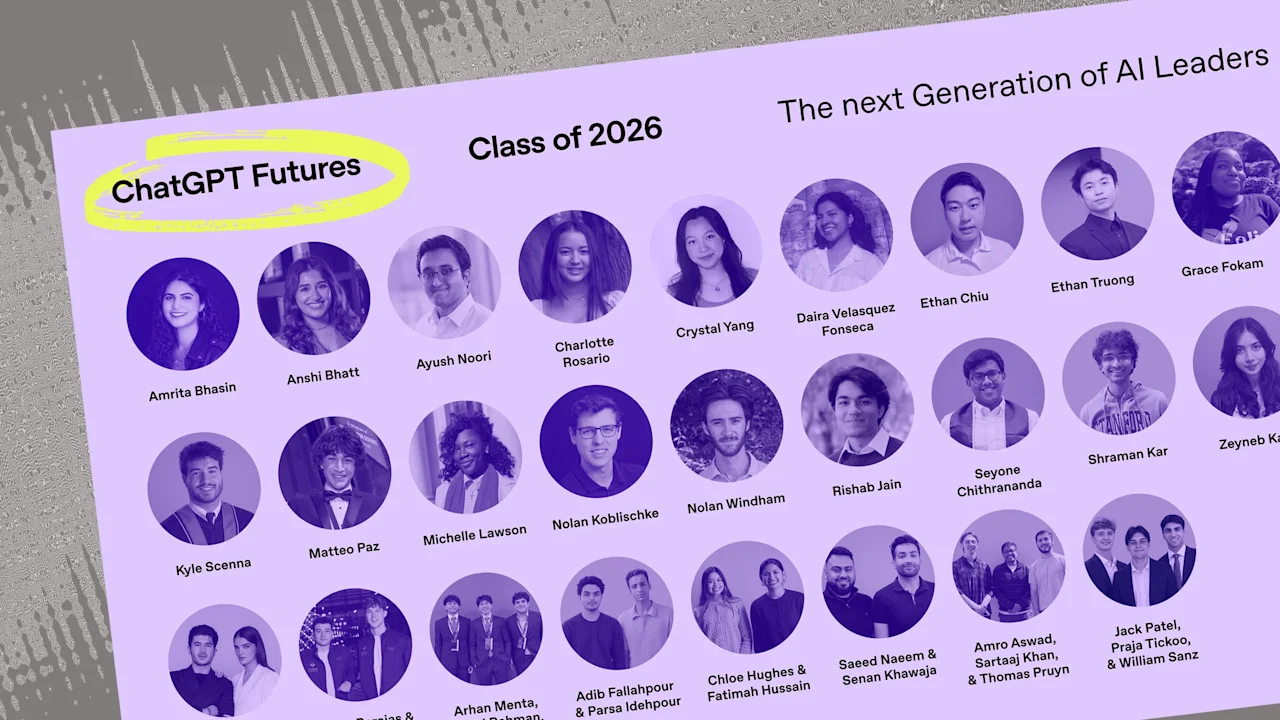
What is the ChatGPT Futures program and who are its winners?
The ChatGPT Futures program, run by OpenAI, awards $10,000 grants to students and young people using AI for positive impact. As OpenAI notes, the graduating class of 2026 is the first cohort to have had ChatGPT available for nearly their entire college experience (since fall 2022). The 26 winners include a wide range of projects: building space robots to assist astronauts, developing methods to find disaster survivors through walls using Wi-Fi signals, helping seniors avoid online scams, and assisting Latin American street vendors with financial tracking. Several honorees focus on science and medicine, such as predicting protein functions, connecting people to mental health resources, and optimizing drug production.
How did Ayush Noori use AI to tackle neurological diseases?
Ayush Noori, a Harvard graduate and current Rhodes Scholar at Oxford, developed a graph AI model called Proton that generates hypotheses about neurological diseases. His motivation comes partly from caring for his late grandmother, who had a rare neurodegenerative condition. Proton has already suggested candidate drugs for bipolar disorder and Alzheimer’s disease, with results validated by lab-grown brain tissue experiments and health record analyses. Noori’s work exemplifies how AI can accelerate research in complex medical fields, potentially leading to new treatments.
What role does AI play in making gaming accessible?
AI has been central to Crystal Yang’s nonprofit Audemy. Beyond coding, AI helped her learn user research, write academic papers, and plug new game ideas into existing templates. She used computer-aided design tools and evaluated console components with AI assistance. The accessible console they are prototyping will rely on audio and tactile features, bypassing the need for visual screens. Yang says AI has been a “very helpful tool throughout,” allowing her to champion accessibility and multiply her capabilities. This shows how AI can empower individuals with limited resources to create inclusive technology.
How are other winners using AI for social good?
Other OpenAI grant winners are applying AI in diverse ways. For instance, one team is building space robots to handle routine astronaut tasks. Another uses Wi-Fi signals to detect disaster survivors through debris. Some are developing AI to protect older adults from online scams. In Latin America, AI helps street vendors track their finances. In medicine, students are creating AI models to predict protein functions, connect people with local mental health resources, and optimize drug manufacturing. These projects demonstrate AI’s versatility in addressing real-world challenges—from space exploration to public health.
What does the ChatGPT Futures program reveal about the next generation of AI users?
According to Leah Belsky, head of education at OpenAI, these students are “using AI to build things that many wouldn’t have previously thought were possible.” The ChatGPT Futures program highlights a shift: AI is no longer just a tool for experts but a platform for young innovators to solve problems they care about. From creating accessible games (see question 1) to advancing neurological research (see question 3), the winners prove that with AI, a single idea can have far-reaching impact. The program also underscores the importance of early exposure to AI in education, empowering students to become creators rather than just consumers of technology.