Hermes Agent and Qwen 3.6: The Future of Self-Improving AI on Local Hardware
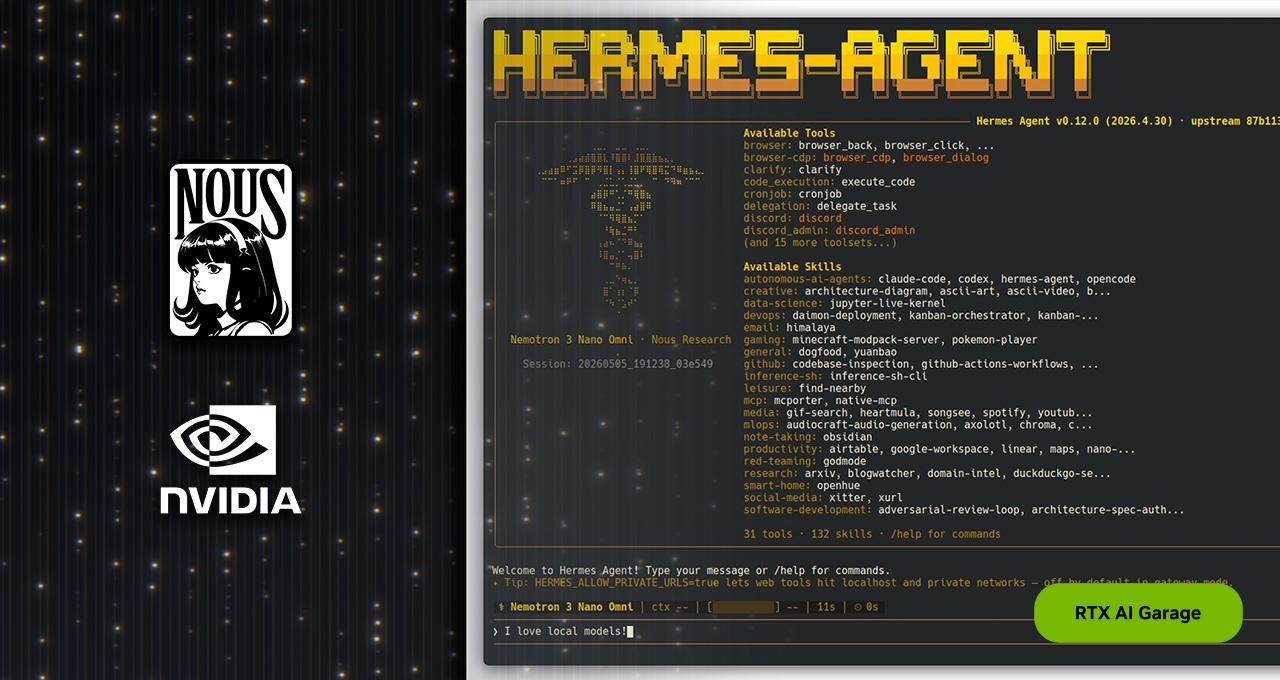
Agentic AI is transforming how we interact with technology, and open-source frameworks are leading the charge. Among the newest and most innovative is Hermes Agent, developed by Nous Research. It has quickly become the most used agent globally on OpenRouter, surpassing 140,000 GitHub stars in under three months. What sets Hermes apart is its focus on reliability and self-improvement, optimized for always-on local use. Paired with NVIDIA RTX PCs, RTX PRO workstations, or the DGX Spark, Hermes runs at full speed around the clock. Complementing this ecosystem is Qwen 3.6 from Alibaba — a series of high-performance, open-weight LLMs that deliver data center-level intelligence locally. Together, they unlock a new era of autonomous, self-evolving AI agents that run entirely on your own hardware.
What is Hermes Agent and why has it gained popularity?
Hermes Agent is an open-source framework for building autonomous AI agents that can operate locally, without relying on cloud services. Developed by Nous Research, it stands out for its ability to self-improve and its reliability by design. Within three months of release, it crossed 140,000 GitHub stars and became the most used agent on OpenRouter, reflecting strong community adoption. Unlike many agent frameworks that require constant debugging, Hermes is provider- and model-agnostic, meaning it works with various language models and can integrate with messaging apps, local files, and applications 24/7. Its popularity stems from its unique capabilities: self-evolving skills, contained sub-agents, and consistent performance even with smaller models like those in the 30-billion-parameter range. Developers praise it for delivering stronger results using identical models compared to other frameworks, thanks to its active orchestration layer rather than a thin wrapper. This makes Hermes a top choice for anyone wanting a persistent, on-device AI assistant.
How does Hermes Agent learn and improve over time?
A key differentiator of Hermes Agent is its self-evolving skills system. When the agent encounters a complex task or receives user feedback, it doesn’t just complete the action — it saves the learnings as a new skill. Over time, Hermes writes and refines its own skill library, allowing it to adapt and perform better on similar tasks in the future. This continuous improvement cycle means the agent becomes more efficient and personalized the more it is used. Unlike traditional agents that rely on static, pre-programmed abilities, Hermes actively learns from experience. All skills, tools, and plug-ins shipped with the framework are curated and stress-tested by Nous Research, ensuring that even newly acquired skills integrate seamlessly. This self-improvement mechanism is especially valuable for local AI agents, where users want a system that grows smarter without needing cloud updates.
What are contained sub-agents and why are they important for local models?
Hermes Agent employs contained sub-agents — short-lived, isolated workers dedicated to specific sub-tasks. Each sub-agent operates within a focused context and with a limited set of tools. This design keeps task organization tidy and minimizes confusion for the main agent. For local models, this is especially beneficial because it allows Hermes to run with smaller context windows, which are more memory-efficient and faster on consumer hardware. Contained sub-agents also improve reliability: if a sub-agent fails, it doesn’t corrupt the entire workflow. They are spawned only when needed and then terminated, reducing resource consumption. This architecture is a major reason why Hermes delivers robust performance even on NVIDIA RTX PCs and DGX Spark, which are designed for accelerated AI but still have limited memory compared to data center hardware. The result is a scalable, safe, and efficient agent system.
Why are NVIDIA RTX PCs and DGX Spark ideal for running Hermes Agent?
Hermes Agent is optimized for always-on local use, and the quality of the hardware directly determines the user experience. NVIDIA RTX GPUs are purpose-built for AI workloads, featuring Tensor Cores and high memory bandwidth that accelerate inference for large language models. The RTX 40 series and RTX PRO workstations can run 30-billion-parameter models efficiently, while the NVIDIA DGX Spark provides even more power for demanding tasks. Since Hermes is designed to run 24/7, these systems offer the reliability and performance needed for continuous operation without throttling. Moreover, the new Qwen 3.6 models, which can run on RTX GPUs with as little as 20GB of memory, further lower the barrier. With NVIDIA hardware, users can take full advantage of Hermes’ self-improving capabilities and sub-agent architecture, achieving data center-level intelligence on a local machine.

What is Qwen 3.6 and how does it enhance local AI agents?
Qwen 3.6 is a new series of high-performance, open-weight large language models from Alibaba. Available in 27-billion and 35-billion parameter versions, these models significantly outperform previous-generation models with 120 billion or even 400 billion parameters, yet require far less memory. For instance, the Qwen 3.6 35B model runs on roughly 20GB of memory while surpassing the accuracy of a 120B model that needed over 70GB. This efficiency makes Qwen 3.6 an ideal foundation for local agents like Hermes, as it enables powerful AI reasoning on consumer GPUs. The models are also optimized for NVIDIA RTX and DGX Spark hardware, delivering accelerated agentic AI. By pairing Hermes with Qwen 3.6, developers get a smarter, faster, and more memory-efficient local AI agent that can run continuously without cloud dependence.
How does hardware quality affect the performance of local AI agents?
The performance of local AI agents like Hermes is directly tied to the hardware they run on. Since models are processed entirely on-device, features like inference speed, memory capacity, and stability depend on the GPU or NPU. A powerful GPU such as an NVIDIA RTX 4090 or a workstation-class RTX PRO can handle larger context windows, faster token generation, and more complex sub-agent workflows. Conversely, weaker hardware may lead to slower responses, frequent crashes, or inability to run models with higher parameter counts. The NVIDIA DGX Spark, with its dedicated AI acceleration, offers an even smoother experience for heavy continuous use. As Hermes encourages always-on operation and self-improvement through repeated tasks, users benefit most from hardware that can sustain high performance over time. Investing in capable hardware like RTX-powered systems ensures that the agent learns faster, runs reliably, and delivers a truly autonomous experience.